
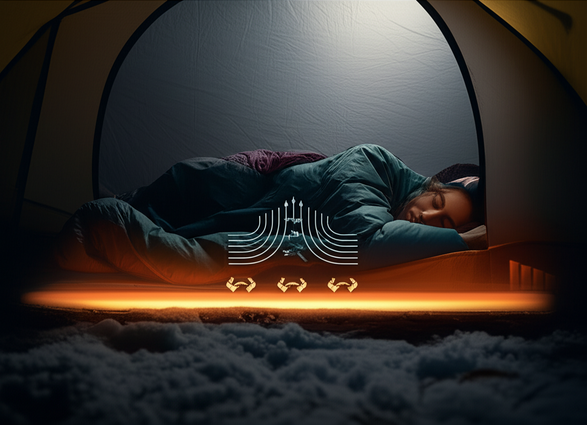
When planning your next outdoor adventure, understanding a sleeping pad’s R-value is as crucial as packing the right layers. The R-value is a standardized measure of a material’s thermal resistance, quantifying its ability to prevent heat loss from your body to the cold ground. For campers and backpackers, this number is your key to a warm and comfortable night, safeguarding against the discomfort of cold seeping through your sleep system.
A higher R-value indicates superior insulation, meaning more warmth. Conversely, a lower R-value suggests less insulation, making it suitable for warmer conditions. Sleeping pads insulate primarily by trapping air within their structure, which slows down heat transfer. While factors like inflation can affect this, the R-value provides a reliable baseline.


From Experience
In our experience, underestimating a sleeping pad’s R-value is a common mistake that can lead to a truly miserable night outdoors. We’ve found that even on shoulder-season trips with moderate temperatures, having an R-value of at least 2.5 provides a noticeable comfort upgrade, especially when the ground is damp. Clients we’ve worked with often share stories of how simply stacking a closed-cell foam pad with an inflatable one dramatically improved their warmth on winter expeditions. Real-world results consistently show that proper R-value selection, combined with mindful inflation, is pivotal for restful sleep in the backcountry.
What is R-Value? Decoding Your Sleeping Pad’s Insulation Score
When preparing for an outdoor overnight adventure, one of the most crucial numbers to understand for a good night’s sleep is a sleeping pad’s R-value. Simply put, R-value is a measurement of a material’s resistance to heat flow, or its thermal resistance. For sleeping pads, this number quantifies how effectively the pad can prevent your body heat from escaping into the cold ground beneath you.
The “R” in R-value stands for thermal resistance, and a higher R-value indicates greater insulation and warmth. For instance, a pad with an R-value of 4 will offer significantly more warmth than one with an R-value of 1. This insulation is achieved through various methods, including trapping air within the pad’s structure, using synthetic or down insulation, and incorporating reflective barriers.
Since 2020, sleeping pad R-values have been standardized under the ASTM F3340-18 test, ensuring consistent and comparable ratings across different brands. This means you can confidently compare R-values when choosing a pad for varying temperatures, from summer camping (R-value 1-2) to extreme winter conditions (R-value 5+). Understanding this score is key to staying warm and comfortable during your outdoor excursions.
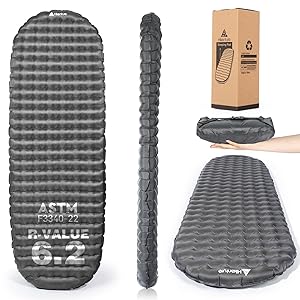


Beyond the Air: How Sleeping Pads Truly Insulate You From the Cold
Beyond simple air pockets, modern sleeping pads employ a sophisticated combination of design elements and materials to keep you warm throughout the night. The key to understanding this insulation lies in its R-value, a standardized measure of a material’s resistance to heat flow. The higher the R-value, the better the insulation.
At its core, insulation aims to prevent convective heat loss – the transfer of heat away from your body by moving air. Sleeping pads achieve this through:
- Trapped Air and Baffles: While air pockets are crucial, it’s the trapped air that insulates. Internal baffles, chambers, or horizontal/vertical tubes within inflatable pads prevent air from circulating freely. This static air significantly slows heat transfer from your body to the cold ground.
- Insulating Materials: Many pads incorporate synthetic or down fills within their air chambers, similar to sleeping bags. These materials, like Primaloft or goose down, excel at trapping tiny air pockets, further boosting insulation without excessive weight. Closed-cell foam pads, often used alone or in conjunction with inflatable pads, are made of a dense matrix of closed air cells that provide excellent, consistent insulation,
- Reflective Layers: Some advanced pads include a thin, metallized layer that reflects your body heat back to you and deflects cold from the ground. This radiant barrier significantly enhances thermal efficiency with minimal added bulk.
Since 2020, sleeping pad R-values are tested under a standardized ASTM F3340 protocol, making it easier to compare insulation across different brands and choose the right pad for your anticipated temperatures. For extremely cold conditions, remember that stacking a closed-cell foam pad under an inflatable pad effectively combines their R-values for superior warmth.
Picking Your Pad: Matching R-Value to Conditions & The New Standard
Choosing the right sleeping pad R-value is crucial for a comfortable night outdoors. R-value measures a pad’s thermal resistance, indicating how well it insulates you from the cold ground. A higher R-value means more warmth, preventing your body heat from escaping into the earth.
To match your pad to conditions:
- Summer (40°F+): An R-value of 1.0-2.0 is often sufficient for mild nights.
- 3-Season (20-40°F): Aim for 2.0-4.0 for spring, fall, and cooler summer nights.
- Winter (Below 20°F): An R-value of 4.0-5.0 or higher is recommended for cold weather and snow. For extreme cold, stacking two pads can significantly increase their combined R-value.
Before 2020, comparing pads was confusing due to inconsistent testing methods among manufacturers. Now, the ASTM F3340-18 standard provides a unified, industry-wide method for measuring R-values. This means an R-value of 4 from one brand is now directly comparable to an R-value of 4 from another, simplifying your decision-making and ensuring you get the insulation you expect. Always look for pads compliant with this standard for reliable warmth and accurate comparisons.
Mastering Your Setup: Pro Tips for Maximizing Comfort & Confident Purchases
Understanding your sleeping pad’s insulation is key to a comfortable night outdoors. The primary measure of this insulation is its R-value, which quantifies a material’s resistance to heat flow, or its thermal resistance. A higher R-value indicates better insulation, meaning less body heat will escape into the cold ground beneath you. Pads achieve this by trapping air within their structure, which slows the transfer of heat.
To ensure consistency across brands, the outdoor industry adopted the ASTM F3340-18 standard for measuring R-value in 2020. This allows for direct, reliable comparisons when purchasing. Generally, an R-value of 1-2 is suitable for summer, 2-4 for three-season use, and 4+ for winter conditions.


Pro Tips for Maximizing Warmth & Comfort:
- Stacking Pads: For extreme cold or added comfort, combine two pads. A foam pad underneath an inflatable one can significantly boost your overall R-value and protect the inflatable from punctures.
- Proper Inflation: While a firm pad might feel good, over-inflating an air pad can compress the internal baffles, reducing its ability to trap air and insulate effectively. Conversely, under-inflation leads to cold spots as your body sinks through the pad. Find the sweet spot for optimal warmth and comfort.
- Ground Insulation: Always clear your sleeping area of debris. Adding a ground cloth or even a space blanket under your pad can offer an additional layer of protection from the cold, wet ground.
By understanding R-value and employing these strategies, you can confidently select and utilize your sleeping pad to ensure warm, restful nights on all your adventures.